

|
Chapter 2:
Chapter 2 isolates a number of characteristics that typify states adopting public financing measures. In one of the major conclusions of the study, this chapter shows that the characteristics of states adopting only simple grant systems are starkly different from those of states adopting partial and full public financing systems. Possible explanations for this dichotomy are advanced in Chapter 3. Chapter 2 begins by examining party control of state legislatures and concludes that adoption of partial and full public financing measures through traditional legislative mechanisms occurs only in states largely under Democratic Party control. The chapter then goes on to examine five major sets of measurable characteristics, partisanship and ideology, regionalism, socioeconomic levels and social modernization, civic culture and democratization, and racial and ethnic diversity. Finally, this chapter considers issues of state political culture, as first articulated by Daniel Elazar over thirty-five years ago. The studies and indexes used to examine the more quantifiable factors come from a variety of different sources and methods. To facilitate easy communication of the major findings of the study, I have standardized most of the indexes to a mean of zero and a standard deviation of one. If the resulting indices are normally distributed, 68% of the variation occurs between plus and minus one. Virtually all variation occurs within three standard deviations of the mean. Thus, differences of even half of a standard deviation are substantively important. Party Control Nearly all public financing measures have been adopted through the traditional legislative route requiring passage through both houses of the legislature and the governor’s signature. Thus, it is important to determine whether the party in control of the state government significantly affects the chances of the implementation of public financing measures. Table 2.1 indicates the party in control of both houses of the legislature and the governor’s office at the time of the implementation or significant reform of every public financing initiative.[52] The table is organized by date within the type of initiative adopted. Table 2.1: Party Control of Government at the Time of Public Financing Adoption and Reform
Simple Grant Systems Party control has a significant effect on the chances of public financing being adopted by states. Sixteen states have implemented and/or reformed simple grant public financing provisions. Six of these measures, making up 38% of the total, were implemented in state governments totally controlled by the Democratic Party. Implementation of simple grant public financing measures by split governments turned out to be relatively symmetrical. Three measures, or 19% of the total, were implemented by split governments with the Democrats controlling both houses of the legislature and by split governments with Republicans controlling both houses of the legislature. Two simple grant measures, or 13% of the total, were adopted by states where Republicans and Democrats each controlled one house of the legislature. However, only two states, Iowa and Idaho, implemented public financing measures when the Republican Party controlled the entire state government. Overall, nine simple grant measures, or 56% of the total were implemented by states with fully Democratic controlled governments or Democratic controlled legislatures. In contrast five simple grant measures, or 31% of the total were implemented by states with fully Republican controlled governments or Republican controlled legislatures. Partial Systems Party control is an even more striking determinant with the more comprehensive partial public financing systems. Fifteen states have implemented or significantly expanded partial public financing systems. Of these, the Democratic Party controlled the entire government in nine states, or 60% of the total. The Democratic Party controlled both houses of the legislature while a Republican was governor in four states, comprising 27% of the total. The legislature was split between Democratic and Republican control in one state, making up 7% of the total. Finally, one state, Nebraska, has a unicameral non-partisan assembly, but a Democratic governor was in office when the partial public financing system was adopted. Significantly, no states where the Republican Party controlled the entire government or both houses of the legislature has ever implemented or expanded partial public financing measures. Thus, states where the Democratic Party controlled the entire government or both houses of the legislature made up 87% of the cases where partial public financing measures have been adopted or reformed. Full Systems Party control is less relevant in states which have implemented full public financing measures, since three out of four of these measures were adopted by direct democracy ballot measures. In fact, policy entrepreneurs in these three states cited the unwillingness of the legislature to pass significant campaign finance reform as the main reason they chose to pursue reforms through the ballot measure process. In the session preceding the public financing ballot measures, Republicans and Democrats split control of the Maine state legislature, Democrats dominated the Massachusetts legislature but faced a Republican governor, and Republicans ran the entire government of Arizona. Democrats controlled the government of Vermont, the only state to adopt a full public financing measure through the legislative process. Thus, Republican opposition may have played a significant role in determining the direct democracy strategy of public financing entrepreneurs in Maine, Arizona, and Massachusetts. In summary, public financing measures were significantly more likely to be adopted when Democrats enjoyed significant or sole power within the government. More comprehensive public financing measures, including partial and full public financing have never been implemented through the legislative mechanism when Republicans controlled the entire state government or even both houses of the legislature. Thus, to use Kingdon’s terminology, Democratic control of the legislature seems to be a necessary condition for the creation of a policy window where public financing legislation is seriously considered. Reasons for Democratic support of public financing legislation may include an ideological belief in limiting the influence of wealthy individuals, a political interest in minimizing the pervasive Republican advantage in fundraising, and a willingness to use government to solve perceived problems. It is likely that Republican opposition derives from similar, though opposite, motivations. Ideological Tendencies within State Populations Party control of state legislatures can only serve as a partial predictive mechanism. Ideology within the same political party varies greatly across states. The composition and issue positions of the Democratic Party in many southern states during the 1970’s may have diverged greatly from Democratic Parties in the Northeast or Far West. To correct for these differences one must attempt to determine the underlying ideologies of the parties and electorates in the American states. David Nice, the only political scientist to directly address the relationship of party ideology to public financing, used data generated by Eugene McGregor in 1978 to examine the nature of the parties in states which implemented public financing.[56] Mcgregor’s findings are relatively dubious and outdated since they are based mainly on Democratic convention roll calls from the 1950’s through the early 1970’s. In their 1993 study Statehouse Democracy, Robert Erikson, Gerald Wright, and John McIver combined over a decade of polling and survey data to establish the partisanship and ideology of state electorates and elites. In a set of earlier studies, Erikson, Wright, and McIver show a significant correlation between public opinion, political elite opinion, and the ideological policy tendencies in American states.[57] Thus, the Statehouse Democracy data may be one of the most accurate indicators available of state party ideology in the 1970’s and 1980’s. Erikson, Wright, and McIver use data from CBS News-New York Times polls conducted between 1976 and 1988 to determine the self-identified partisan and ideology profiles of citizens in the lower forty-eight states.[58] In these surveys, respondents identified their party affiliation as Democratic, Independent, or Republican and described their ideology as Liberal, Moderate, or Conservative.[59] Assuming that Erikson’s data proving a strong correlation between public opinion and political positions and initiatives of state political actors is correct, it is possible to form a rough chart establishing the political center of gravity in given states. There does not seem to be a significant correlation between a state’s self-identified partisanship and adoption of public financing. As Figure 2.1 illustrates below, there this only about 1/10 of a standard deviation between the percentages of citizens in states with partial or full public financing identifying themselves as Republican and Democratic and the percentages in states without any public financing. Simple Grant states trend more significantly Republican, which distinguishes them from both of the other categories. However, the variation is again relatively minor, so that overall Figure 2.1 seems to illustrate that Democratic control of the legislature, rather than the national partisan tilt of the state’s electorate plays a more direct role in determining public financing adoption.Figure 2.1: Mean Partisanship of States
Figure 2.2: Overall State Ideology[60]
I t is also possible to examine state party ideology by measuring the ideology of respondents who described themselves as Democrats and Republicans. States that have adopted full or partial public financing have more liberal Democratic and Republican parties. However, Figures 2.3 and 2.4 show that contrary to Nice’s hypotheses, relative Democratic liberal ideology shows a greater correspondence to public financing adoption than relative Republican liberal ideology. The difference between Democratic ideology in partial and full public financing states approaches half of a standard deviation. In contrast, the Republican ideologies of these same states are separated by only 1/5 of a standard deviation, a relatively insignificant difference. The correspondence between liberal Democratic parties and public financing adoption is likely explained by the earlier determination that comprehensive public financing is only adopted when Democrats control state legislatures.Figure 2.3: Democratic Party Mass Ideology
Figure 2.4: Republican Party Mass Ideology
Figures 2.3 and 2.4 also shows that the political party ideologies in Simple Grant states are far more polarized than in states with comprehensive or no public financing. Figure 2.5 illustrates this finding more clearly by calculating and standardizing the difference between respective party ideologies. Positive correspondence indicates higher than average levels of polarization. Thus, in states with simple grant public financing, Republican parties tend to be more conservative, and Democratic parties tend to be more liberal than the national average. This political polarization may partially account for the emphasis on strong political parties implied by the institution of simple grant party public financing. Figure 2.5: Party Polarization
Regional Similarities and Issue Diffusion States within a given region often have similar values, policy norms, and political structures.[61] Thus, a number of political scientists have argued that "region may serve as a surrogate for political culture in most cases."[62] The advantage of looking for patterns through simple regional location is that the data, through its very simplicity, is more reliable and less subjective than more abstract conceptions of political characteristics or culture. Figure 2.6 shows all the states in the US which have adopted public financing systems, with darker shades indicating states which have implemented partial or full public financing. Figure 2.6: States that have Adopted Public
Financing of Elections
Table 2.2 sorts this data by the United States Census classification of the country in nine regional divisions:[63] Table 2.2: The Regional Distribution of Public Financing
The distribution of generic public financing adoption according to Census Bureau divisions does not show many striking patterns. Between 50%-70% of states in six of the nine divisions have implemented some sort of public financing system. The region with the highest proportion is the East North Central, where Illinois is the only state to not have adopted some form of public financing system. In contrast, no state in the West South Central region of Arkansas, Louisiana, Oklahoma, and Texas has implemented public financing. The distribution patterns for states which have implemented more comprehensive partial or full systems of public financing are significant. The New England states are the clear leader in this category, followed by the East North Central region. In contrast, the West South Central and Pacific regions have no statewide partial or full public financing measures, followed closely by the Mountain states where only Arizona has a recently implemented a full public financing measure.[65] However, significant intra-regional patterns are evident as well. The four regions with the highest percentage of full or partial public financing are the four contiguous North East and North Central regions, which spread from New England across the Great Lakes to Minnesota, Nebraska, and the Dakotas. Further exploration will be undertaken later to determine why this cross-regional pattern of public financing exists. A major question that arises from the regional patterns of public financing implementation is whether significant diffusion of information or ideas has occurred within regions during the adoption process. The survey data presented in Chapter 3 shows considerable testimonial evidence that state entrepreneurs were aware and affected by of the actions of neighboring states in the years proceeding the New England full public financing initiatives of the 1990’s. However, the data is less conclusive concerning earlier measures instituted in other regions of the country. Thus, before delving into the specific cultures and characteristics of the twenty-seven states that have implemented public financing of elections, it is useful to examine any similarities within regions in type and timing of public financing measures. Figure 2.7 shows four regional groupings of three or more states, each of which instituted or reformed similar public financing systems within two election cycles of each other. Figure 2.7: Possible Areas of Regional Diffusion
in Public Financing Adoption
The earliest of these groupings is a set of New England states, which includes Maine, Massachusetts, and Rhode Island. All three states implemented roughly analogous simple grant funding provisions for political parties between 1973 and 1975. In a separate but similar grouping, Maine and Massachusetts joined with Vermont between 1996 and 1998 in establishing structurally similar full public financing systems for political candidates through the ballot measure mechanism. In 1992, Rhode Island established a partial public financing system for statewide candidates, but interviews and surveys from the New England states (as outlined in Chapter 3) indicate that this reform was not a major impetus for the subsequent full public financing initiatives to the north. The second major grouping consists of three Great Lakes states, Michigan, Minnesota, and Wisconsin, which established partial public financing systems for statewide candidates between 1974 and 1977.[66] Indiana and Iowa also established public payments to political parties during this time period, but the significantly different nature of these public financing systems (both from Michigan, Minnesota, and Wisconsin and from each other) indicate that their origins may not have come from the same concerns or innovations as the systems of their neighbors. The final potential area of regional diffusion of public financing initiatives is in the mountain states of Idaho, Montana, and Utah. All three of these states established simple grants to political parties funded by similar tax check-off mechanisms between 1973 and 1975. Although very little supplemental evidence from surveys or interviews exists for these systems, their extreme similarity would indicate that conscious diffusion did occur. Finally, implementation of full public financing measures seems to be closely related to the state ballot initiative process. Figure 2.8 shows that the majority of states allowing statutory ballot measures lie west of the Mississippi River. This regional concentration may hold the historical key to ballot initiative adoption. The first non-constitutional citizen ballot initiative took place in 1904 and the practice became popular only in the 1910’s and 1920’s, propelled forward by rising education levels and the popularity of the national constitutional amendment process.[67] During this period, the statutory tradition of Eastern states had been developing for at least one hundred years, whereas the constitutions and common laws on the more recent western states may have still been in flux. Figure 2.8: States Allowing Statutory Ballot
Initiatives as of 2000[68]
Economic Modernization and Social Development Indexes Since the 1960’s a number of theories have been advances equating socioeconomic development and modernization with policy tendencies and outcomes. In 1975, Ira Sharkansky drew on this literature to advance a controversial theory that many less developed portions of the United States still resembled developing countries in their political, governmental and public policy arenas.[69] According to Sharkansky’s argument, government policies and structures were mainly a reflection of specific levels of modernization and development. This field of literature has continued to develop. Two modern indices show that there is a significant correlation between modernization and socioeconomic development and the adoption of public financing. There is still serious controversy surrounding measures of modernization. Thus, it may be wise to begin simply. Most social scientists can agree that education is the most basic measure of social development while income is the most universal indicator of economic development. Thus, to determine broad trends in the adoption of public financing, it makes sense to start with a study of 1990 education levels and per capita income of the fifty states developed by Tom Rice and Marshall Arnett.[70] Figure 2.6 shows that the average socioeconomic development of states with partial and full public financing measures is substantially higher than that of states with no public financing. Thus, since public financing is costly, this dichotomy seems to indicate that state resources matter in determining adoption of public financing systems. Figure 2.9 also shows that states with simple grant systems tend to have lower levels of socioeconomic development than states without any public financing or with more comprehensive systems. The interview findings of Chapter 3, which indicate that unlike partial and full public financing legislation simple grant systems are rarely the result of significant citizen initiative, may provide a partial explanation of this correspondence. Figure 2.9: Socioeconomic Development
Urbanization and social structure shifts which accompany modernization are also important measures of development. One of the most comprehensive studies examining these issues is 1997 index of modernization developed by David R. Morgan and Kenneth Kickham as a re-examination of the earliest state modernization analysis completed by John Crittenden in 1967.[71] Morgan and Kickham base their study around John Coleman’s assertion that:
Attempting to quantify this definition, Morgan and Kickham analyzed thirty-three social and economic variables from the late 1980’s and early 1990’s to isolate three major factors which characterize modern states: metro-urbanism, migratory pull, and political involvement. They then weighted these factors to provide a modernization index of all fifty states. By standardizing Morgan and Kickhams measures and sorting them according to public financing adoption, one can see in Figure 2.7 a relationship between higher levels of modernization and adoption of public financing, though this correlation is less striking than that shown by Rice and Arnett’s socioeconomic index above. The smaller average modernization differences between states with partial and full public financing and those with no such systems indicates that public financing is more affected by higher income and education levels than by urban social structures and high levels of mobility. Figure 2.10: Modernization
Civic Culture Undoubtedly issues of ideology and socioeconomic development affect the willingness and ability of state governments to institute expensive and intrusive election reforms such as public financing. However, cultural attitudes toward government, democracy, and civil society may also play important roles in determining whether election reforms reach the agenda of state governments in the first place. In an earlier study to their index of socioeconomic development, Tom Rice and Alexander Sumberg formulate an index of state civic culture.[73] Rice and Sumberg argue that there is widespread agreement among scholars that civic culture is characterized by four overarching characteristics: interpersonal trust and tolerance, a preponderance of voluntary associations, widespread egalitarian values, and significant civic engagement (i.e. an informed and participatory public).[74] Rice and Sumberg quantify these values into a comprehensive measurement of state civic culture. In a subsequent article, Rice and Marshall Arnett use extensive archival data to form parallel indexes of state civic culture for 1930 and 1880.[75] Rice and Arnett find that the civic culture rankings of states stay constant over time and that civic culture seems to inspire increased socioeconomic development rather than the other way around.[76] These findings indicate that cultural issues may shape a variety of state characteristics in the present day. Figure 2.11 shows a modest but meaningful relationship between civic culture and adoption of partial and full public financing. The civic culture of states adopting partial and full public financing is significantly above the mean, whereas the civic culture of states implementing simple grant measures or no public financing at all is below average. Figure 2.11: Civic Culture
State Political Culture The correlation between adoption of comprehensive public financing and higher levels of civic culture open up larger questions about the role of cultural characteristics in state politics. Some of the most decisive predictors of adoption of public financing measures may be attitudes toward change and innovation, government action, and democracy itself, which are not fully illustrated by the studies above. Over the years a number of theories concerning state political culture have been advanced based on geographic characteristics, immigration patterns, urban-rural dichotomies, and class factors. However, surprisingly few attempts have been made to classify states according to political culture. Starting in the 1960’s, Thomas Dye and others advanced economic based theories of political culture, arguing that state culture and consequently public policy could be predicted by the basic socioeconomic development of state economies and populations.[77] Subsequently, Daniel Elazar advanced a revisionist theory in his seminal 1966 work American Federalism which continues to define the study of political culture to this day. Elazar defines political culture as "the particular pattern of orientation to political action in which each political system is imbedded."[78] Elazar contends that the political culture of the United States is made up of three discrete sub-cultures brought to the country by immigrant groups with very distinctive sociocultural differences. Elazar argues that these sub-cultures have spread across the country as it was settled by descendants of these immigrant groups and, though they perpetually evolve, these cultures continue to characterize American political interaction to this day. Nice, mentions Elazar’s theories in his chapter on state public financing. Due to the continuing dominance of Elazar’s archetype, it will be useful to synthesize the existing literature on political culture and American settlement patterns to provide greater dimensionality to Elazar’s model. In addition, it is beneficial to integrate in certain modifications of Elazar’s model developed in the thirty-five years since its first publication.[79] Moralistic Culture In Elazar’s theory, populations characterized by moralistic political culture believe that government should embody the public’s values and exercise its power for the betterment of the community. Democracy and democratically elected officials are accordingly viewed positively as manifestations of the public interest and "public officials will themselves seek to initiate new government activities in an effort to come to grips with problems as yet unperceived by a majority of the citizenry."[80] Moralistic populations have a tendency to value amateur citizen-officials who are held to high standards of public service in the general interest. Policy issues tend to be more important than political parties in the politics of moralistic societies. Consequently the population tends to embrace party switching, third party candidacies, and non-partisan competition as long as these are grounded in policy beliefs. According to Elazar, the origin of moralistic culture lies in the Puritan settlement of New England. The cultural historian David Hackett Fischer confirms many of Elazar’s contentions through his profile of the common conception of "publick liberty" as "something which belonged not to an individual but to an entire community" in the East Anglian region of England where most New England Puritan’s haled from.[81] As Elazar asserts, "[t]he puritans came . . . intending to establish the best possible earthly version of the holy commonwealth" and this orientation continued as Puritan descendants spread across upstate New York and the northern borders of Pennsylvania and Ohio.[82] In the mid-nineteenth century the Puritan migration reached the upper Great Lakes where a sort of "greater New England" was formed in conjunction with recent Scandinavian and Northern European immigrants who shared related cultures and religious traditions.[83] Pushing westward, puritan descendants settled parts of Colorado, Montana, Washington and Oregon, pockets on the California coast, and, much later, most of northern Arizona. In addition, the Mormons settlers of Utah came largely from the Puritan cultural stock of upstate New York and Ohio.[84] Individualistic Culture Communities with individualistic political culture view government and the democratic system largely as a utilitarian marketplace. The citizens of these areas believe government intervention should be focused mainly on facilitating private initiative, efficiency in the economy, and widespread access to the marketplace. Government generally is viewed as slightly dirty and is largely left to the administration of professionals, who, it is assumed, participate for personal and professional gain. Bureaucracy is generally viewed with ambivalence in such societies, so political parties serve as the major organizational entities within the political arena, at times functioning like private sector corporations. To preserve efficiency while preventing disruption, individualistic "political culture encourages the maintenance of a party system that is competitive, but not overly so, in the pursuit of office."[85] In individualistic systems, new policies are rarely initiated by government actors and result mainly from public demand.[86] The origins of the individualistic sub-culture lie in the interior Germanic and non-puritan English settlers of the Middle Atlantic, encompassing New York, New Jersey, Pennsylvania, Delaware, and Maryland. The major impetus of these settlers was the search for individual opportunity in the New World. Thus, "[u]nlike the Puritans who sought communal as well as individualistic goals in their migrations, the pursuit of private ends pre-dominated among the settlers of the middle states."[87] Even relatively unified communities, such as the Quakers of Pennsylvania, derived a "libertarian heritage" from "a later generation [and] another region of England" than the moralistic Puritans.[88] Thus, "[f]ew public questions were introduced among the colonists [of the Middle Atlantic states] without being discussed in terms of rights and liberties" of the individual.[89] Settlers from these Middle Atlantic states slowly moved westward through central Ohio, Indiana, Illinois, and Missouri before crossing the country to settle California during the goldrush in the 1840’s and 1850’s.[90] Settlers from the California gold fields subsequently settled areas of Nebraska, Wyoming, Nevada, and Alaska in ensuing smaller migrations, often fueled by smaller gold rushes.[91] In an interesting side note, Elazar argues that although later waves of southern and eastern European immigrants were initially characterized by traditionalistic culture, the natural advantages of an individualistic cultural archetype in reconciling culturally disparate immigrant groups caused it to eventually triumph as the dominant culture in most areas. Consequently, many aspects of the individualistic archetype have come to characterize national American political culture. Traditionalistic Culture In Elazar’s formulation, communities with traditionalistic political culture tend to view government as the patriarchal custodian of the hierarchical arrangement of society. Control of the government tends to reside in a self-perpetuating group drawn from the established elite often defined by family ties. Rather than being clean or dirty, government is considered a privilege and citizens lower down in the hierarchy are not expected to actively participate in government, and at times not even vote.[92] In traditionalistic societies, policy is sometimes initiated by political actors, but only when it serves the interests or perpetuates the power of the ruling elite. In the past, competition within traditional societies has been largely conducted by factions within one-party systems. The immigrants who originally populated the Southeast coast of the United States came from the same areas as those from the middle Atlantic states. However, according to a number of colonial historians, the potential cash crops of the region caused the settlers to emulate the agrarianism they observed from the landed gentry of the Old World.[93] Fischer profiles the swift establishment of a Virginia elite by Cavalier gentry of Western England exiled by the Civil War of the 1640’s.[94] In certain southern states, such as North Carolina, a moralistic populism was added to the cultural milieu by significant Scotch-Irish immigration in the eighteenth century.[95] Traditionalistic culture spread as southeastern Americans pushed west through the southern United States (including southern Indiana and Illinois) into Texas, New Mexico, and Arizona (integrating with the slightly individualistic French culture along the Mississippi as it went). In areas populated partially by the Appalachian Scots-Irish, such as portions of Tennessee, Kentucky, and Missouri, certain elements of moralistic populism were introduced. More recently, in the twentieth century, parts of Texas, New Mexico, Arizona, and Florida were populated by individualistic and moralistic immigrants from the Northeast.[96] Traditionalistic culture is largely tied to pre-industrial economies, and has been slowly transitioning into a form of individualistic culture as economic development and integration have transformed the South. However, significant traditionalistic elements remain in many states. Predictions Based on Political Culture Based on the archetypes outlined above, one can make predictions as to the types of states which would adopt public financing systems. Because of the impetus to maintain clean, citizen-based political systems in moralistic systems, one would expect that these states would adopt the most radical forms of public financing, especially full and partial systems funding candidates in exchange for specific "moral" behaviors. Erikson, Wright, and McIver find significant evidence that moralistic political culture corresponds with increased liberalism of the political elite, even when the states population is not correspondingly liberal.[97] Thus, the positive view the elites in moralistic political cultures have toward innovation and government intervention would indicate that moralistic states might be the first to implement significant public financing measures. Individualistic cultures would likely view public financing initiatives with the same skepticism they view most government action. The possible exceptions to this suspicion might be instances where populist elements (which can characterize individualistic systems) came to construe public financing as a measure to improve individual opportunity to gain from access to the political system. The research of Erikson, Wright, and McIver confirms Elazar’s assertion that elites in individualistic societies are more concerned with maintaining political power than implementing or opposing particular policies.[98] Thus, campaign corruption scandals which elicited sufficient public outcry might initiate public financing adoption. Generally, the negative view of individualistic elites toward innovation would indicate that individualistic states would emulate existing public financing archetypes rather than initiating new systems. It is likely that traditionalistic political cultures would oppose public financing systems that might threaten to upset the political hierarchy. In contrast, traditional societies might embrace simple grant systems which allocate money to political parties with no strings attached. However, traditionalistic societies would likely tend to oppose more comprehensive candidate based public financing systems, especially systems covering lower "door-keeping" offices such as state legislative races. Traditionalistic societies would also likely lag behind moralistic communities in instituting public financing, especially more comprehensive systems. In American Federalism, Elazar creates a triangulated spectrum between the Moralistic, Individualistic, and Traditionalistic archetypes. He then designates the political culture of every state along this spectrum largely based on immigration patterns and field observations.[99] Some states are given a modified classification, such as individualistic-moralistic if disparate political cultures have evolved together over time or if significant pockets of a minority political culture exists. In these cases, the first culture listed, such as individualistic in the example above, is considered the dominant culture while the second culture listed, moralistic in the case above, is the sub-dominant culture. Elazar’s state rankings have remained unchanged since the first edition of American Federalism in 1966. It is important to note that Elazar’s determinations are not intended to be absolute, as culture is constantly changing. However, they are designed to be accurate predictors of tendencies within states. Subsequent research has determined that Elazar’s classifications have functioned as significant predictors of at least six variables: government activities, local emphasis, innovative activity by the government, encouragement of popular participation in elections, popular participation in elections, and party competition.[100] However, other than a brief mention by David Nice (Policy Innovation in State Government, 1994), political culture has never been used to examine the origins of public financing of elections. Having established expectations based on Elazar’s basic theories, it is now possible to apply them to the states with existing public financing systems to determine whether political culture is an accurate predictor of public financing adoption. Figure 2.12: Distribution of Public Financing
within Elazar’s Political Culture Framework[101]
Figure 2.12 shows the number of states adopting public financing measures sorted by Elazar’s political culture calculations.[102] As would be expected, a plurality of the public financing systems have occurred in states with dominant moralistic culture and a clear majority in states with significant moralistic impulses. Elazar classifies roughly equal numbers of states as having dominant moralistic, individualistic, and traditionalistic cultures. However, upon integrating in sub-dominant cultures as well, there is significant variation between the number of states in each of his nine categories. Elazar defines ten states as traditionalistic-individualistic but defines none as moralistic-traditionalistic. Figure 2.13 breaks down public financing systems according to Elazar’s political culture values. In addition, since states with no public financing are included at the bottom of the chart, the total size of each column represents the number of states Elazar places in each category. Figure 2.13: Types of Public Financing Systems
Adopted within Elazar’s Classifications
Using this graph we can see that party based simple grant systems are more common in predominantly moralistic or traditionalistic states. However, surprisingly, partial and full public financing systems are nearly as common in states with dominant or sub-dominant individualistic culture as in states with dominant or sub-dominant moralistic culture. For further evidence concerning partial public financing adoption, one can turn to municipal systems, all of which are partial. Figure 2.14 uses Elazar’s cultural classifications of metropolitan areas to show the cultural characteristics of communities which have implemented public financing of municipal elections.[103] Figure 2.14: Public Financing Distributed by
Metropolitan Political Culture
Municipal public financing systems also have a tendency to appear in areas with moralistic-individualistic or individualistic-moralistic culture. Though a larger percentage municipal systems occur in areas with dominant moralistic culture than for state systems, it is clear in both examples that a certain number of communities with significant individualistic impulses have implemented public finance systems. Possible Reasons for the Adoption of Public Financing by Individualistic and Traditionalistic States The apparent anomaly of traditionalistic and individualistic states adopting relatively comprehensive campaign finance reforms can be partially explained by the survey and interview data presented in the following chapter. However, some preliminary observations can be advanced by examining the timing and nature of partial public financing systems implemented by states without significant moralistic cultural components.[104] Table 2.3: States Without Significant Moralistic Culture Adopting Public Financing
The only state implementing its partial public financing system in the initial wave of public financing legislation during the mid-1970’s was New Jersey. Maryland also adopted the outlines of its system in 1974. However, implementation of the system was successively delayed until 1994 because the Maryland legislature refused to budget sufficient funding for the system and repealed all funding mechanisms in 1982 (subsequently the public campaign fund grew only by interest on the initial investment). Thus, only New Jersey’s system was implemented during the height of public financing legislation in the mid-1970’s. Although the data set is very small, it is notable that the more individualistic states adopted their partial public financing measures during approximately the same period as more moralistic states whereas the more traditionalistic states tended to implement their systems significantly later.[105] In addition, the partial public financing systems of individualistic and traditionalistic states generally apply only to larger statewide offices and often only to the Governors and Lt. Governors races. This is what one might expect in traditional and individualistic systems where systems to empower candidates, if implemented at all, would likely be restricted to higher offices open only to elite candidates who have already passed through the glass ceiling of lower offices. The one state that partially bucks this trend is Hawaii, which appropriates very small grants of $50 to legislative and local races.[106] It seems likely that these grants are designed mainly to oblige low level candidates to follow the spending limits imposed along with the public funds. Finally, the actual mechanisms used to raise funds for public financing may influence the adoption of such systems in certain states. It would stand to reason that individualistic states would be more likely to adopt partial public financing if the funding mechanisms of these systems were based on individual choice rather than legislative initiative. This hypothesis seems to hold up, as the partial public financing systems in more individualistic states are funded by optional tax check-off and tax add-on mechanisms while the systems in more traditional states are funded by yearly legislative action to appropriate money from the state’s budget.[107] An analysis of some of the characteristics of the partial public financing systems implemented in states with predominantly individualistic or traditionalistic political cultures does shed light on some of the reasons that these systems may have been more palatable to legislators and the electorate. However, certain states, such as Hawaii, seem to buck the major trends apparent among non-moralistic systems. Furthermore, an analysis of how partial public financing systems may have been adapted according to each state’s cultural proclivities still does not fully explain why such systems were considered in the first place by states with non-moralistic political proclivities. The answer lies in the particular circumstances surrounding the consideration and adoption of each of these individual measures. These factors will be examined in the succeeding chapter.Modifications to Elazar’s Classification System Certain modifications of Elazar’s classifications have been proposed over the years. Shortly after the first edition of American Federalism Ira Sharkansky proposed that a more accurate grid of political culture would be presented by a single spectrum with moralistic and traditionalistic political culture on the extremes and individualistic culture representing the exact mid-point in between.[108] Sharkansky presented significant research concerning government intervention in social and economic matters in states to back up his model. His modifications, which imply that individualistic states contain significant moralistic characteristics, would also be helpful in explaining the adoption of public financing by predominantly individualistic states. On the other hand, the weaknesses of Sharkansky’s model lie in the fact that it was developed to explain government intervention in social and economic rather than political fields. In addition, fully embracing Sharkansky would cut out many of the distinctive characteristics of individualistic political culture, such as its emphasis on private initiative and party structure.Subsequent to Sharkansky, Charles Johnson proposed a simplification of Elazar’s method of calculating political culture while retaining Elazar’s basic descriptive model.[109] Elazar had based his calculations on a variety of factors including population flows, urbanization, and past public policy. However, Johnson, citing the lack of truly reliable data, chose to base calculations of state culture solely on religious affiliation, since it was easily traceable using modern census data. Johnson added to Elazar’s work of determining the denomination and sub-denomination of the basic moralistic-individualistic-traditionalistic populations pools and recalculated the political cultures of states using the religious affiliation of their populations.[110] It is important to note that Johnson does not assume that there is a direct causal relationship between religious affiliation and political culture. Rather, he uses data on religious affiliation as a useful marker for tracking the flow of political cultures and thereby verifying Elazar’s conclusions of the political cultures of individual states. The general shape of Johnson’s calculations correspond to Elazar’s findings. However, Johnson’s figures indicate a shift of nine marginally moralistic and traditionalistic states into the individualistic category. By intent or chance, Elazar’s findings divide the country up into even thirds, with seventeen states classified as having dominant moralistic culture, seventeen states having dominant individualistic culture, and sixteen states having dominant traditionalistic culture. In contrast Johnson’s calculations classify twenty-four states as individualistic and twelve states each as moralistic and traditionalistic according to their religious demographics.[111] Specifically, Johnson shifts all of New England and most of the Great Lakes states from the moralistic to the individualistic column.[112] Table 2.4 shows that the proportion of Johnson’s individualistic states adopting public financing is roughly similar to the proportion of moralistic states adopting such systems according to Elazar’s classifications. Table 2.4: A Comparison of Elazar’s and Johnson’s Public Financing Adoption Rates
Johnson uses significant evidence to show that individualistic, not simply moralistic, states demonstrate increased government innovative activity and greater government encouragement of popular participation. The significant correlation between Johnson’s individualistic political culture and implementation of public financing indicates that individualistic culture may be more complicated than Elazar assumes. In the end, however, a survey of the literature indicates that there is not a compelling reason to modify Elazar’s classification scheme unless one accepts more fundamental criticisms of his approach. Critiques of Elazar’s Archetype Elazar’s classifications are attractive to political scientists because they incorporate a historical element of analysis usually missing from state studies and use relatively universal impressions of state cultural tendencies to make wide-ranging predictions of political characteristics and governmental policies. They have become the dominant benchmark for political culture because of the attractiveness of this theoretical model and the high predictive rate Elazar’s values tend to have in estimating state based policy characteristics. They have withstood extensive empirical testing and over 100 modern studies have used Elazar’s political culture argument.[113] However, despite their usefulness in predicting the adoption of public financing, Elazar’s formulations do contain serious drawbacks. Most problematic is that fact that Elazar’s political sub-cultures are not based on any rigorous statistical data denoting specific characteristics. In addition his classifications of states along his cultural spectrum are not based on hard empirical data, instead drawing heavily from interviews, field observations, and academic studies of American regions and ethnoreligious identities.[114] Elazar’s state classifications have remained unchanged for over thirty-five years and three editions of Elazar’s American Federalism even as immigration, political participation, and technological patterns have shifted.[115] Even the studies of historical migration patterns which underlie Elazar’s cultural geology, and which are undoubtedly the most innovative, influential, and rigorous element of his theory, contain very little data from after the Second World War.[116] Finally, the fact that Elazar bases his predictions of future political behavior at least partially on observations of past political behavior, leaves him open to criticism that his schema is circular or descriptive, rather than an exploration of the sources of political culture.[117] It is important to address these criticisms. A significant criticism of Elazar’s formulation of moralistic political culture was leveled by Richard Ellis in American Political Cultures by the contention that Elazar’s moralistic culture is largely split between an egalitarian communalist and a hierarchical collectivist ethos which also typifies many traditionalistic cultures. Ellis, whose thoughts reflect an earlier articulation by Aaron Wildavsky and Michael Thompson, claims, "[I]t will not do to throw the radical abolitionism of William Lloyd Garrison and the hierarchical Whiggery of Daniel Webster, the patriarchal mormonism [sic] of Joseph Smith and the egalitarian communalism of Hopedale, the leveling of the populists and the paternalism of the Mugwumps, into the same cultural melting pot."[118] Elazar addressed much of Ellis’ criticism with his subsequent profile of the subtle differences between the first fifteen waves of American immigration in The American Mosaic.[119] However, Ellis’ basic point remains valid. It may very well be that both moralistic and traditionalistic cultures contain communal and collectivist elements, with the defining characteristic between them being their attitude toward equality. Considering the lack of empirical evidence underlining Elazar’s formulations, in order to confirm any plausible connection between moralistic culture and the adoption of public financing, one must determine whether the characteristics Elazar uses to define moralist political culture actually typify the states which have adopted public financing measures. Cultural attitudes toward government, democracy, and civil society are of the utmost importance when examining patterns in public financing. Thus, setting aside concerns of circularity for a moment, it may be useful to test the applicability of Elazar’s formulations to the study of public financing by comparing them to a widely known index of democratization for the 1980’s developed by Kim Hill which measures the right to vote, voter turnout, and party competition during the decade.[120] Figure 2.15 demonstrates a significant correlation between high democratization levels and Elazar’s moralistic archetype. The average moralistic state has a democratization level over 1.5 standard deviations greater than the average level among traditionalistic states. Interestingly, the relative democratization of individualistic states lies much closer to that of moralistic states than that of traditionalistic states. In keeping with Elazar’s theories, individualistic states tend to have slightly higher levels of party competition, but lower levels of popular participation than moralistic states.[121] These findings lend some empirical evidence to the assumption that Elazar’s classifications correspond to the political mentality of the American people. Figure 2.15: Mean Democratization Levels of
Elazar’s Archetypes
However, Elazar’s formulations do suffer from the potential of significant circular logic. In 1993 Joel Lieske attempted to solve Elazar’s circularity problem by profiling the interplay of four factors he took to be the building blocks of Elazar’s political culture; racial origin, ethnic ancestry, religious orientation, and social structure.[122] Lieske draws heavily on Aaron Wildavsky’s theory of culture as a system of shared values reinforcing a favored set of social relationships and posits that regional subcultures within the United States are the "products of historical interactions between the cultural preferences of different ethno-religious settler groups and the nationally centripetal and regionally centrifugal demands of their environments."[123] Lieske uses forty-five indicators of race, ethnicity, religion, and social structure to profile thirteen distinctive American clusters of characteristics which he posits are sub-cultures.[124] His formulations pose a challenge since he maps them by county rather than state. However, upon examining the cultural make-up of states implementing public financing it is striking that the majority of them occur in areas typified by ethnic similarities.[125] Areas with predominantly white populations united by relatively homogeneous German and Irish ancestry are most likely to adopt simple grant public financing measures.[126] In contrast, partial and full public financing measures are most common in areas currently populated by ethnically diverse European populations. However, many of these ethnically diverse states were originally inhabited by Northern Europeans of Anglo-Saxon heritage and still exhibit some social characteristics and government policies similar to states which maintain majority Northern European populations.[127] The minority of public financing states with homogeneous Northern European populations tend to be typified by religious orientations—Methodist, Presbyterian, Episcopalian, Congregationalist, and Lutheran—which could be termed Liberal Protestant, but this is the only major religious commonality evident among regions with high percentages of public financing.[128] Areas of high African American concentration are the least likely to implement public financing, especially the more comprehensive partial and full public financing measures.[129] Lieske’s research indicates that issues of race and ethnicity may be very important factors in determining the cultural characteristics associated with public financing adoption. Social Diversity A compelling race and ethnicity based revision of political culture theory was recently advanced by Rodney Hero in 1998.[130] Hero presents significant evidence to prove that Elazar’s cultural formulations are actually reflections of political attitudes shaped by the ethnic and racial diversity of state populations, which he terms social diversity. By shifting the basis of cultural classifications away from early European immigration, historical migration patterns, and circular field observations in favor of quantifiable diversity indexes, Hero avoids many of the major problems of Elazar’s formulations. It will shortly be shown that the ethnic and racial make-up of states seem to influence issues of ideology and culture which affect the probability of public financing adoption. Strikingly, there is a significant correlation between Hero’s social diversity indexes and Elazar’s political culture classifications. Low minority diversity seems to have a positive correspondence with moralistic political culture, with fully fifteen of seventeen states (or 88%) with dominant moralistic culture falling below the mean of minority diversity. In contrast, high white ethnic diversity holds a significant positive correspondence to Elazar’s individualistic culture. Eleven of the seventeen states (or 64%) with dominant individualistic culture fall above the mean of white ethnic diversity, and these states make up 73% of the states above the mean in this index. Finally, there is a correlation between Elazar’s traditionalistic culture and both high minority populations and low ethnic diversity. Twelve of the sixteen dominant traditionalistic states (or 75%) have above average levels of minority diversity and fifteen of the sixteen states (or 94%) have below average levels of white ethnic diversity. The significant connection between Elazar’s cultural classifications and Hero’s diversity index, may indicate that ethnic and racial diversity does play an important role in shaping political culture. However, it is also important to explore the significant differences between Hero and Elazar’s systems. Hero, replaces Elazar’s moralistic, individualistic, and traditionalistic archetypes with a classification of states as homogeneous, heterogeneous, or bifurcated. The heterogeneous classification can also be split into simple and complex categories depending on the size of their minority populations. Table 2.5: Summary of the Ethnic & Racial Characteristics of Hero’s State Classifications
The lines between Hero’s classifications are determined by mean levels of racial and ethnic diversity for all fifty states. Figure 2.16: The Social Diversity of States with Public Financing (Bold italics indicate partial and full public financing) (Click thumbnail for larger image)
Significant evidence indicates that Hero’s classifications are indeed strongly related to state attitudes and policies concerning democracy and political participation. Figure 2.17 shows that the democratization levels between Hero’s bifurcated and homogeneous states are strikingly similar to those between Elazar’s traditionalistic and moralistic states.[131] Figure 2.17: Democratization Levels of Hero’s
Archetypes
Having established the strengths of Hero’s theories, it is now beneficial to compare the social diversity index to the adoption of public financing.[132] Figure 2.18 shows that comprehensive public financing states tend to be characterized by significant levels of white ethnic diversity. Figure 2.19 illustrates a similar correspondence between public financing adoption and relatively small minority populations. Figure 2.18: Ethnic Diversity of States with
Public Financing
Figure 2.19: Minority Diversity of States with
Public Financing
Combining white ethnic and racial diversity into a unified social diversity index reveals two disparate trends. Seven of the thirteen states (or 54%) with simple grant public financing have homogeneous populations and five out of the thirteen (or 38%) have bifurcated populations. However, only one out of the thirteen states with simple grants has a heterogeneous population. In contrast, heterogeneous states make up seven out of fourteen (or 50%) of the partial and full public financing systems, with homogeneous states making up 36% and bifurcated states making up only 14%.[133] Some of this distribution may be explained by factors already discussed. For instance, the low incidence of public financing in southern states may be predicable based on historical proclivities. Hill’s democratization index confirms the prevailing assumption that bifurcated states, which are typically southern, have historically placed the least emphasis on democratic empowerment or independent political dialogue because, one might assume, of a fear of increasing the influence of African Americans. Notably, the only two bifurcated states with full or partial public financing systems are Arizona and Hawaii, whose predominantly Hispanic and Asian minorities may be less threatening to their dominant white cultures. Party public financing seems to be slightly more acceptable to bifurcated states since it tends to solidify established power brokers rather than empowering traditionally disenfranchised constituencies. However, partial and full public financing systems, which tend to empower candidates over parties and increase electoral competition, are predictably uncommon in bifurcated states. In recent years, a literature has emerged arguing that the egalitarianism of the progressive movement was only possible in states with low minority populations, and subsided as minority diversity increased.[134] Recently, Peter Schrag profiled California’s shift from an egalitarian toward a more paranoid political culture as the state’s minority diversity increased in his study Paradise Lost: California’s Experience, America’s Future.[135] This argument lends weight to Hero’s assertion that "greater freedom for issue politics may exist where there is less [minority] diversity because the political stakes are not starkly defined in racial . . . terms."[136] It could be posited that political cultures which prioritize issue-based politics may have a greater interest in preserving political equality and dialogue through public financing of both political parties and candidates. The frequent occurrence of partial and full public financing in heterogeneous states is more difficult to explain. It is relevant to note that five out of the eight heterogeneous states with public financing have relatively low levels of white ethnic diversity for heterogeneous states. However, there are also a number of states and cities with public financing, such as Rhode Island, Massachusetts, New Jersey, Los Angeles, and New York City, whose original Northern European populations have been virtually overwhelmed by white ethnic immigrants in the last century. This chapter has already determined that moralistic political culture is not the only factor which increases the likelihood of public financing adoption. Figure 2.20 corresponds the Democratic party liberalism derived from Erikson, Wright, and McIver’s Statehouse Democracy with Hero’s social diversity categories. Strikingly, white ethnic diversity seems to have a high correspondence with Democratic Party liberalism. As was discussed earlier in the chapter, political party liberalism within states has a clear correspondence with the implementation of comprehensive public financing. In contrast, homogeneous and bifurcated states both have relatively conservative Democratic party ideologies, which seems to indicates that racial diversity is not a significant factor in party ideology. Figure 2.20: The Democratic Party Liberalism of
Hero’s Social Diversity Categories
Traditional wisdom has held that while ethnically diverse areas may be characterized by significant social policy liberalism, they are rarely typified by open and egalitarian politics. At times, this has led to strangely discongruous political situations, such as President Kennedy’s strikingly liberal policy initiatives even as he was propelled to victory in his senate and presidential races by a ruthless Irish political machine. In a possible counterweight to this tendency, it is striking that the vast majority of instances of comprehensive public financing occur in heterogeneous states which, according to Elazar’s migration studies, were originally populated by Northern European populations and where significant moralistic culture is still present, if no longer dominant. Lieske’s study lends further credence to the theory that original Northern European values and social structures may have remained dominant in many areas even as they experienced significant white ethnic immigration. Thus, it may be that the most conducive environment for partial and full public financing adoption is provided by societies with a combination of liberal Democratic Parties produced by large white ethnic populations and pervasive concern for citizen participation and clean government, perpetuated by older moralistic cultural tendencies. Conclusions This chapter finds a significant difference between the characteristics of states adopting simple grant public financing systems and states adopting more comprehensive partial and full public financing systems. In almost every category examined the characteristics of simple grant states bear greater resemblance to the categories of states with no public financing than to states with more comprehensive systems. This, lends weight to the supposition that partial and full public financing systems are different not simply in degree but also in kind from the less comprehensive simple grant public financing systems. Democratic Party control of state legislatures is shown to be necessary for the adoption of partial and full public financing systems through the legislative mechanism. However, the overall partisanship of state populations is shown to bear no correspondence to the implementation of public financing. In contrast, high levels of liberal ideology, and especially high liberal ideology among members of the state Democratic Party, is shown to bear a significant correspondence to adoption of partial and full public financing systems. It can be posited that the positive view of interventionist government policies which characterizes modern day liberal ideology lends itself to experimentation with public financing systems. In many cases, high levels of white ethnic diversity within state populations directly correspond with Democratic Party liberalism. This may be due to a combination of traditional cultural proclivities and social and economic circumstances in which recent white ethnic immigrants found themselves in upon immigrating to the United States. These environmental factors may account for the correspondence between comprehensive public financing adoption and Morgan and Kickham’s modernization index, which places significant emphasis on issues of urbanization. In addition to high levels of liberalism, this study determines a positive correspondence between high levels of socioeconomic development and adoption of comprehensive public financing systems. Undoubtedly states with high levels of per capita income have more resources to devote toward new initiatives. In addition, education levels may affect political participation and the diffusion of ideas. Rice and Arnett argue that socioeconomic development is at least somewhat affected by civic culture, which may provide the base levels of social harmony and government responsiveness necessary for sustained economic development. Examination of Rice and Arnett’s index shows that high levels of civic culture do bear some correspondence to implementation of comprehensive public financing. However, it is unclear whether this relationship is direct, or works indirectly through socioeconomic development. In America, states with the lowest levels of socioeconomic development generally tend to be historically characterized by low levels of democratization and civic culture. Elazar would attribute this correspondence to the attitudes accompanying traditionalistic culture, which is in turn formed by historical and environmental factors. Hero’s would attribute the low levels of democratization, socioeconomic development, and public financing adoption of more traditionalistic states to the basic racial makeup of these societies. This chapter does not purport to explain why public financing was adopted by specific states at specific times. However, it does advance important findings concerning the political, economic, and social factors which accompany adoption of comprehensive public financing. Chapter 3 examines many of these findings in the context of Kingdon’s theory of policy generation and specific case studies examining the circumstances and actions which lead to the adoption of public financing in particular states.
|
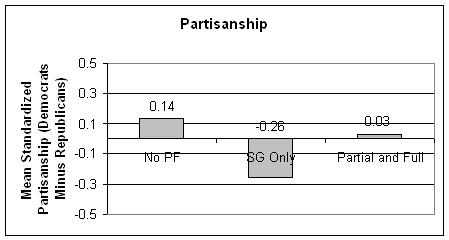
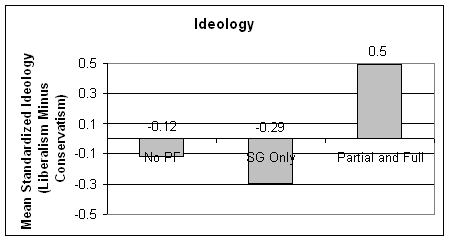
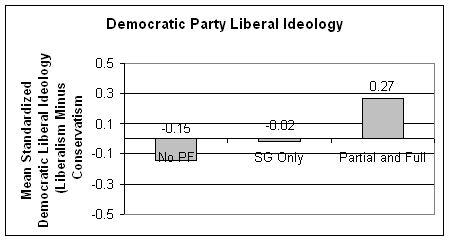
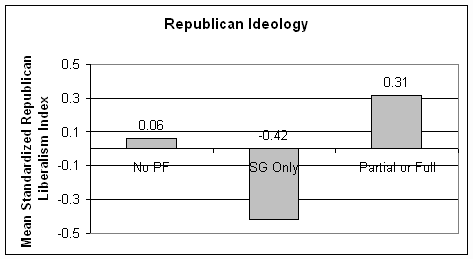
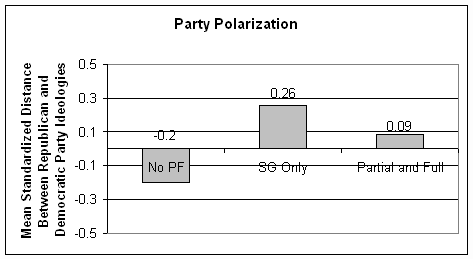
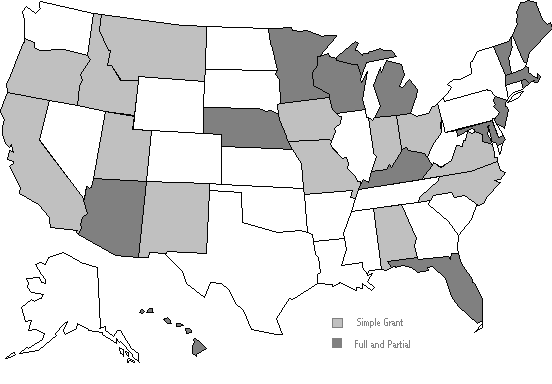
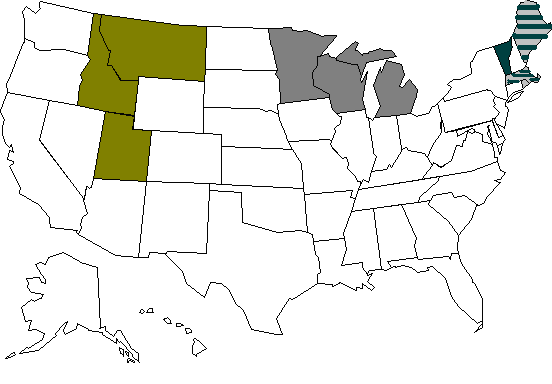
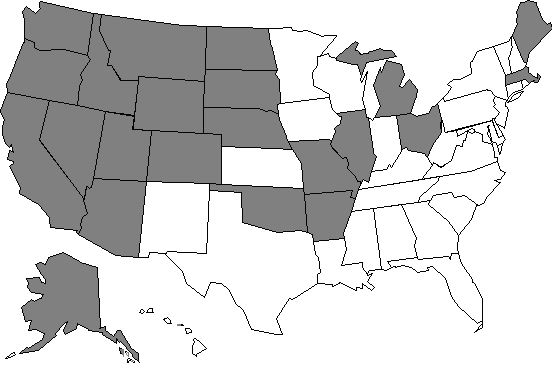
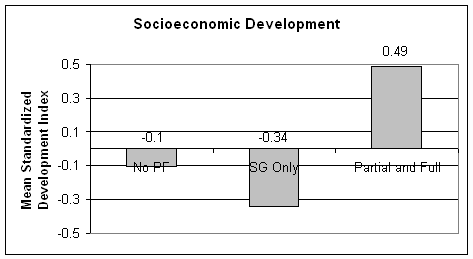
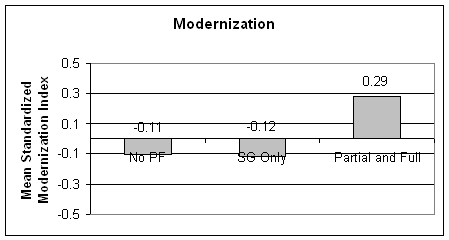
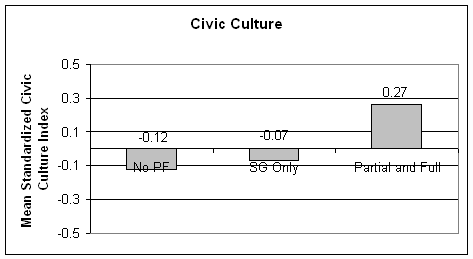
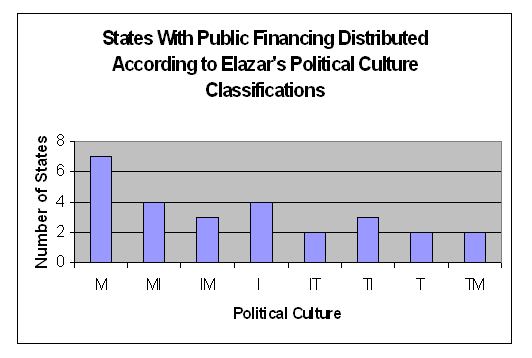
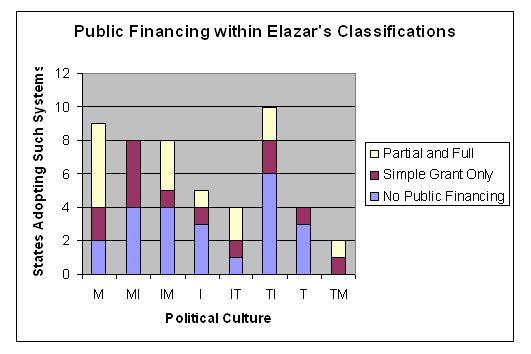
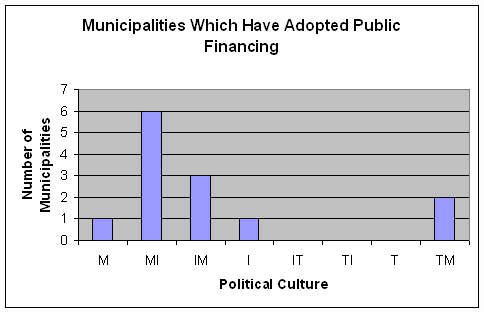
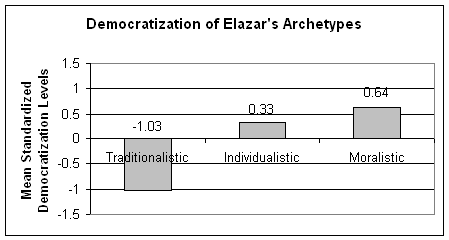
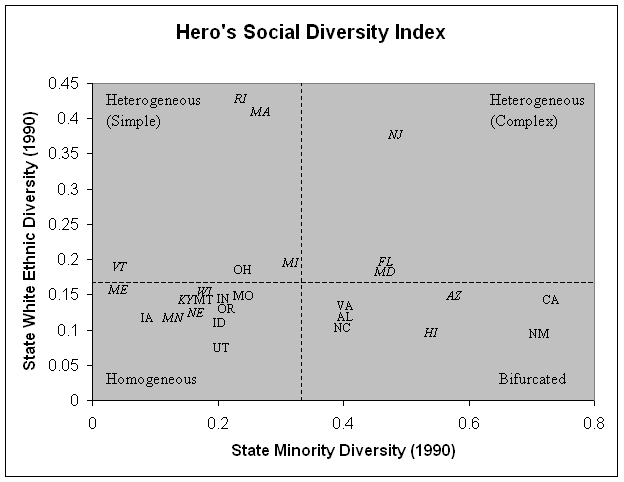
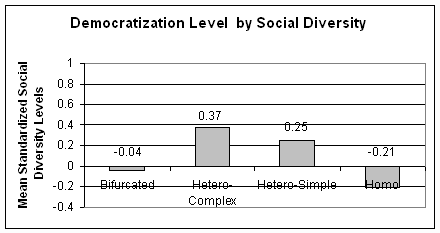
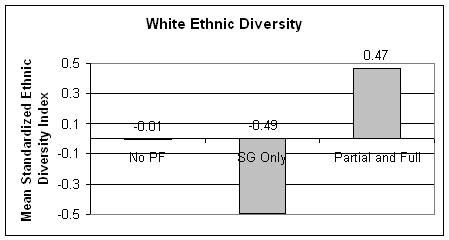
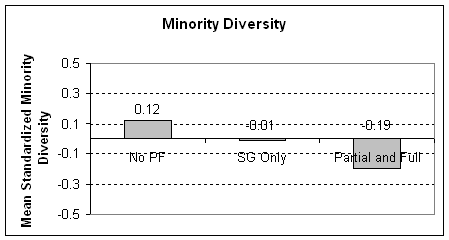
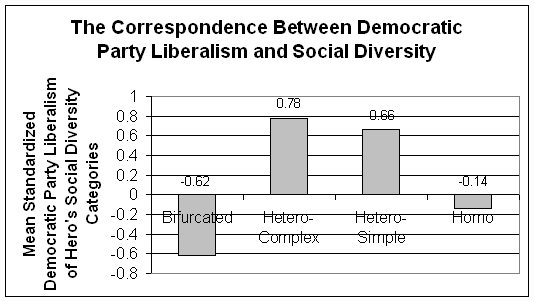

| Footnotes: [52] Data derived from Legislative Data Tables (unpublished) secured from the National Conference of State Legislatures Denver, Colorado www.ncsl.org. Data crosschecked for accuracy through The Council of State Governments The Book of the States The Council of State Governments Louisville, KY 2000 www.csg.org. [53] SG denotes Simple Grant. [54] For the House, Senate, and Governor Columns, D indicates Democrat control, R indicates Republican control, and I indicates Independent control. [55] S denotes split control of the institutions of government. However, because the interviews and surveys presented in chapter 3 indicate that public financing initiatives were usually initiated in the legislature, control of the legislature is indicated in parenthesis if one party controlled both houses. [56] Nice uses data from Eugene McGregor’s 1978 study McGregor, Eugene “Uncertainty and National Nominating Coalitions.” Journal of Politics v. 40 1978 pp. 1011-1043 [57] Erikson’s conclusions are presented in two articles: Erikson, Robert, Gerald Wright, and John McIver “Political Parties, Public Opinion, and State Policy in the United States” in the American Political Science Review v. 83, n. 3 1989 pp. 729-750 and Wright, Gerald, Robert Erikson, and John McIver “Public Opinion and Policy Liberalism in the American States” in the American Journal of Political Science, v. 31, n. 4 1987 pp. 980-1001. Erikson’s findings serve as a partial refutation of the theory that policies originate primarily from given levels of socioeconomic development within states which was first formulated by Thomas Dye in Politics in States and Communities Prentice Hall Inc. New Jersey 1969. [58] This exercise is based on an earlier study by Wright, Gerald Robert Erikson, and John McIver “Measuring State Partisanship and Ideology with Survey Data” in The Journal of Politics, v. 47, n. 2 pp. 469-489 1985. [59] As in any survey, there is a chance that respondents do not answer accurately because of pre-existing connotations or differing perceptions as to the meaning of the identification terms. There is significantly less danger of this in the partisanship portion of the survey, as party identification is relatively straightforward. The partisanship figures of the surveys of Wright et al. correspond to the partisanship findings of a number of other party identification surveys, including the “Comparative State Elections Project” contained in Black, Merle, David Kovenock, and William Reynolds Political Attitudes in the Nation and the States. Institute for Research in the Social Sciences Chapel Hill NC 1974 and from the “Network of State Polls” cited in Jewell, Malcolm “State Polls” Comparative State Politics Newsletter v. 1 1980 p. 15. Wright, Erikson, and McIver’s data on ideology is harder to corroborate. Wright et al. correlate their ideology data with the election returns in the 1972 and 1980 presidential elections, which they contend, due to major shifts away from the traditional partisan identifications of voters across the country, were based more on ideology than the traditional partisan affiliation, which has dominated presidential elections before and since. Wright et al. find that their poll data on state ideology is at least partially reflected by the vote tallies in the ideological presidential votes in 1972 and 1980. [60] Data for Hawaii and Alaska are not included in Erikson, Wright, and McIver’s study. [61] Erikson et al. present a compelling case for the relevance of states as political units in ch. 3 of Statehouse Democracy. This model was previously extended into regions by Garreau, Joel in The Nine Nations of North America Houghton Mifflin Co. Boston, 1981 [62] Lyons, William & Robert Durant “Assessing the Impact of Immigration on State Political Systems” Social Science Quarterly, v. 61 December 1980 p. 474. One of the earliest of these studies is Ira Sharkansky’s work Regionalism in American Politics Bobbs-Merrill Inc. New York 1970. Regional seepage of innovations was subsequently documented in Moreland, Laurence et al. Contemporary Southern Political Attitudes and Behavior Praeger Publishers New York 1982 and in Gray, Virginia et al. Politics in the American States 4th ed. Little Brown & Co. Boston 1982. [63] The United States Census Regional Divisions only include the lower 48 states. For further information on Census regional divisions go to the Reference map section of the official US Census website at www.census.gov. [64] P/F is used to denote partial and full public financing systems in this and future tables. It is often useful to look at total partial and full public financing as a separate entity from all public financing systems because these more comprehensive systems are significantly different in character, scope, and effect. [65] This conclusion, though fully accurate for statewide systems, may be slightly misleading. Eleven of the fourteen municipal public financing initiatives are contained within the Mountain, Southwest, and Pacific Coast states, with the vast majority existing on the Pacific Coast. All of these local public financing systems could be considered partial schemes according to the definitions outlined in Chapter 1. Thus, there may be significant local factors which make partial campaign financing systems viable on a statewide level in the three Western and South Western regions while preventing such systems from being implemented on a statewide level. These factors will be further explored later in this chapter. [66] Minnesota’s and Wisconsin’s systems included legislative candidates and all statewide officers, whereas Michigan’s system was restricted to Gubernatorial candidates. [67] Sabato, Larry, Howard Ernst, and Bruce Larson eds Dangerous Democracy? The Battle Over Ballot Initiatives in America Rowman & Littlefield Pub. Lanham, MD 2001 pp. 2-5 [68] Data taken from the Council of State Governments The Book of the States, 2000 Lexington, KY 2000 [69] Sharkansky, Ira The United States: A Study of a Developing Country David McKay Co. New York, 1975 [70] Rice, Tom W and Marshall Arnett “Civic Culture and Socioeconomic Development in the United States: A View from the States, 1880’s-1990’s” in The Social Science Journal v. 38 n. 1 2001 pp. 39-51 [71] Morgan, David and Kenneth Kickham “Modernization among the United States: Change and Continuity from 1960 to 1990” in Publius v. 27 n. 3 (Summer) 1997 pp. 23-39. Update of Crittenden, John “Dimensions of Modernization in the American States” in American Political Science Review v. 61 (December 1967) pp. 989-1001 [72] Coleman, James “Conclusion: The Political Systems of Developing Areas” in The Politics of Developing Areas, Gabriel Almond and James Coleman eds, Princeton University Press Princeton, NJ 1960 p. 532 [73] Rice, Tom and Alexander Sumberg “Civic Culture and Government Performance in the American States,” in Publius: The Journal of Federalism v. 27 1990 pp. 99-114 [74] These values and explanations of how Rice and Sumberg quantify them are explained in detail in Rice, Tom W and Marshall Arnett “Civic Culture and Socioeconomic Development in the United States: A View from the States, 1880’s-1990’s” in The Social Science Journal v. 38 n. 1 2001 p. 40 [75] Rice, Tom W and Marshall Arnett “Civic Culture and Socioeconomic Development in the United States: A View from the States, 1880’s-1990’s” in The Social Science Journal v. 38 n. 1 2001 pp. 39-51 [76] Rice and Arnett pp. 42-43 [77] Dye, Thomas Politics, Economics, and the Public: Policy Outcomes in the American States Rand McNally Chicago, 1966 [78] Elazar, Daniel American Federalism: A View from the States 2nd Edition Thomas Crowell Co. New York 1972 pp. 84-85. Note. Editions of Elazar’s work have come out in 1966, 1972, 1984, and (The American Mosaic) 1994. [79] It is important to note that the following explanations are ideal archetypes. In reality, pure cultures characterized by all the factors outlined above rarely exist. [80] Elazar, Daniel American Federalism: A View from the States 2nd Edition Thomas Crowell Co. New York 1972 p. 98 [81] Fischer, David Hackett Albion’s Seed Oxford University Press New York 1989 pp. 199-200 [82] Elazar pp. 108-109 [83] Also see Gilbert, Martin ed. The Dent Atlas of American History 3rd ed. JM Dent Ltd. London 1993 p. 66 [84] Also see Brown, Kent ed. The Historical Atlas of Mormonism Simon & Schuster, New York 1994 [85] Elazar, Daniel American Federalism: A View from the States 2nd Edition Thomas Crowell Co. New York 1972 p. 95 [86] Johnson, Charles “Political Culture in American States: Elazar’s Formulation Examined” in American Journal of Political Science v. 20 no. 3 1976 pp. 500, 503, 506 [87] Elazar p. 109 It should be noted that different variations of the Individualistic moral culture immediately began to develop. Maryland and Delaware began to take on certain traditionalistic traits due to their Tobacco based agricultural economies and significant Catholic populations. Pennsylvania, on the other hand, was founded as a partly moralistic community. However, as one must only read the writings of Benjamin Franklin to detect, the Middle Atlantic moralist impulse was more often then not centered around protecting the very individualistic freedom to strive for private goals which characterized the dominant individualistic culture. [88] Fischer, David Hackett Albion’s Seed Oxford University Press New York 1989 pp. 595, 600 [89] Fischer, pp. 595-597 [90] It should be noted that American settlement indicates that gold and oil rushes have been highly attractive to members of the individualistic subculture and have greatly transformed the cultural geography of the country. [91] Gastil, Raymond Cultural Regions of the United States University of Washington Press Seattle WA 1975 pp. 225-236, 273-282 [92] Johnson, Charles “Political Culture in American States: Elazar’s Formulation Examined” in American Journal of Political Science v. 20 no. 3 1976 p. 503 [93] In addition to Elazar, see Gastil, Raymond Cultural Regions of the United States University of Washington Press Seattle WA 1975 pp. 7-25, and 174-204 [94] Fischer, David Hackett Albion’s Seed Oxford University Press New York 1989 pp. 207-419 [95] Henderson, George and Thompson Olasiji Migrants, Immigrants, and Slaves: Racial and Ethnic Groups in America, University Press of America inc. Lanham, MD 1995 pp. 56-59 Also see Fischer pp. 605-783 [96] See also Jackson, Kenneth ed. Atlas of American History Charles Scribner’s Sons New York 1978 pp. 215-225 [97] Erikson, Statehouse Democracy pp. 158-165 [98] Erikson, Statehouse Democracy pp. 158-165 [99] Elazar bases his calculations on census data and historical documents showing population flows and immigration. However, it must be admitted that Elazar’s actual categorization of states does contain some impressionistic elements. Elazar explains this be simply stating that his formulations are designed to show tendencies rather than specific quantifiable policy outcomes. [100] Erikson, Statehouse Democracy pp. 499-507 [101] The political culture breakdown of states which have adopted public financing runs as follows: Moralistic: ME, MI, MN, OR, UT, VT, WI. Moralistic-Individualistic: CA, IA, ID, MT. Individualistic-Moralistic: MA, NE, RI. Individualistic: IN, MD, NJ, OH. Individualistic-Traditionalistic: HI, MO. Traditionalistic-Individualistic: FL, KY, NM. Traditionalistic: AL, VA. Traditionalistic-Moralistic: AZ, NC. Elazar does not classify any states in the Country as Moralistic-Traditionalistic. [102] Elazar although localized pockets of Moralistic-Traditionalistic culture do exist around the country, Elazar does not does not classify any states as Moralistic-Traditionalistic. [103] Elazar American Federalism pp. 106-107 [104] No full public financing systems have been implemented by states without dominant or sub-dominant moralistic culture [105] Moralistic states adopting partial public financing systems are Minnesota-1974, Michigan-1976, and Wisconsin-1977. Rhode Island adopted a partial public financing system in 1988 and Nebraska implemented its system in 1992. [106] Candidates for the State Legislature and the Honalulu City Council receive the funding of $50. [107] Tax check-offs appropriate a specific portion of a citizen’s tax-payment to fund a given program. Tax add-ons increase a citizens tax burden by a designated amount to fund a given program. Predictably, the participation rate in tax add-on systems tends to be below 1%. Incidentally, moralistic states all fund their partial public financing systems through tax check-off systems as well. [108] Sharkansky, Ira “The Utility of Elazar’s Political Culture: A Research Note” Polity Fall 1969 pp. 66-83 [109] Johnson, Charles “Political Culture in American States: Elazar’s Formulation Examined” in American Journal of Political Science v. 20 no. 3 1976 pp. 491-509 [110] Unlike Elazar, Johnson did not use sub-dominant cultural proclivities and classified all states as moralistic, individualistic, or traditionalistic. For a complete table showing which religions Johnson classifies under each category, see Johnson, p. 493. For Elazar’s earlier charts, see Elazar, Daniel Cities of the Prairie, Basic Books, New York, 1970 [111] Johnson’s study excluded Alaska and Hawaii. [112] Johnson shifts California, Maine, Michigan, Montana, New Hampshire, Vermont and Wisconsin from the moralistic to the individualistic category. He shifts Nevada and New York from the individualistic to the moralistic category. Finally, he shifts Arizona, Louisiana, New Mexico, and West Virginia from the traditionalistic to the individualistic category. [113] Lieske, Joel “Regional Subcultures of the United States” in The Journal of Politics v. 55 n. 4 (November) 1993 pp. 908-909. [114] Furthermore, Elazar’s formulations are based on uneven sampling areas. The local determinations of political sub-cultures on which his state classifications are based are not organized around county or demographic data. Rather, Elazar seems to have studied the major urban and suburban areas in every state and based his analysis on these findings. [115] For an account of some of the testing of Elazar’s formulations see Lieske, p. 889. Editions of American Federalism were issued in 1966, 1972, and 1984. Elazar’s classifications also remained unchanged in the 1994 successor volume to his federalism works, The American Mosaic. [116] Elazar does in fact accept the inevitability of cultural change and spontaneous evolution as part of his conceptions of the western and metropolitan frontier. However, his theory does not explain how these factors have continued to develop in the modern age. [117] Lieske, Joel “Regional Subcultures of the United States” in The Journal of Politics v. 55 n. 4 (November, 1993) p. 889 [118] Ellis, Richard American Political Cultures Oxford University Press, New York, 1993 p. 169 Also see Thompson, Michael, Richard Ellis, and Aaron Wildavsky Cultural Theory Westview Press, Boulder CO 1990 ch. 13 [119] Elazar, Daniel The American Mosaic: The Impact of Space, Time, and Culture on American Politics Westview Press, Boulder, CO 1994 [120] Hill, Kim Democracy in the Fifty States University of Nebraska Press Lincoln, NE 1994 pp. 144-145 [121] Hill, pp. 144-145 [122] Lieske, Joel “Regional Subcultures of the United States” in The Journal of Politics v. 55 n. 4 (November, 1993) pp. 888-913 [123] Lieske p. 891 For Wildavsky’s theories see Wildavsky, Aaron “Choosing Preferences by Constructing Institutions: A Cultural Theory of Preference Formation” in The American Political Science Review v. 81 1987 pp. 3-21 [124] Lieske’s names his subcultures Agrarian, Anglo-French, Asian, Black Belt, Border, Ethnic, Germanic, Heartland, Hispanic, Mormon, Native, Nordic, and Rurban. For Lieske’s complete county map see Lieske p. 907 (Figure 2) [125] Further proof of the lack of patterns in religious orientation different from ethnic origin can be found in Elazar, Daniel and Joseph Zikmund The Ecology of American Political Culture: Readings Thomas Crowell Company New York 1974 pp. 158-164 [126] An analysis of Lieske’s county data indicates that the following states typified by Germanic and Irish heritage have implemented public financing: Irish (with some Germanic): AL, CA, FL, ID, KY, MI, MO, NC, OR, VA. Predominantly Germanic or Nordic: IA, MN, MT, NE, OH, WI [127] An analysis of Lieske’s county data indicates that the following states typified by Ethnic populations and some Anglo-French social tendencies have implemented partial or full public financing: Ethnic: FL, MA, MD, MI, NJ, RI. For further information on these tendencies see Lieske p. 909. [128] For additional information on Liberal Protestant beliefs see Fowler, Robert Booth Religion and Politics in America Westview Press Boulder, CO 1995 pp. 4-14, 39-42, 63-67 [129] Of areas with the highest African American concentration, only Alabama and North Carolina have implemented Public Financing. Neither of these are partial or full public financing measures. [130] Hero, Rodney Faces of Inequality: Social Diversity in American Politics Oxford University Press, New York 1998 [131] Hill, Kim Democracy in the Fifty States University of Nebraska Press Lincoln, NE 1994 pp. 144-145 [132] Overall, Hero classifies 20 states as homogeneous, 15 states as heterogeneous (7 Simple and 8 complex), and 15 states as bifurcated [133] The borders of Hero’s classifications are defined by the mean levels of racial diversity and white ethnic diversity between the states. It must be noted, however, that four of the seven heterogeneous states with partial or full public financing systems lie very close to the mean of white ethnic diversity, and are thus much less diverse that the figures above might lead one to believe. [134] For a pointed synopsis of this argument see Schwarz, Benjamin “The Diversity Myth” in The Atlantic Monthly, v. 275 n. 5 May 1995 pp. 57-67 [135] Schrag, Peter Paradise Lost: California’s Experience, America’s Future New Press New York, 1998 [136] Hero, p. 53 |